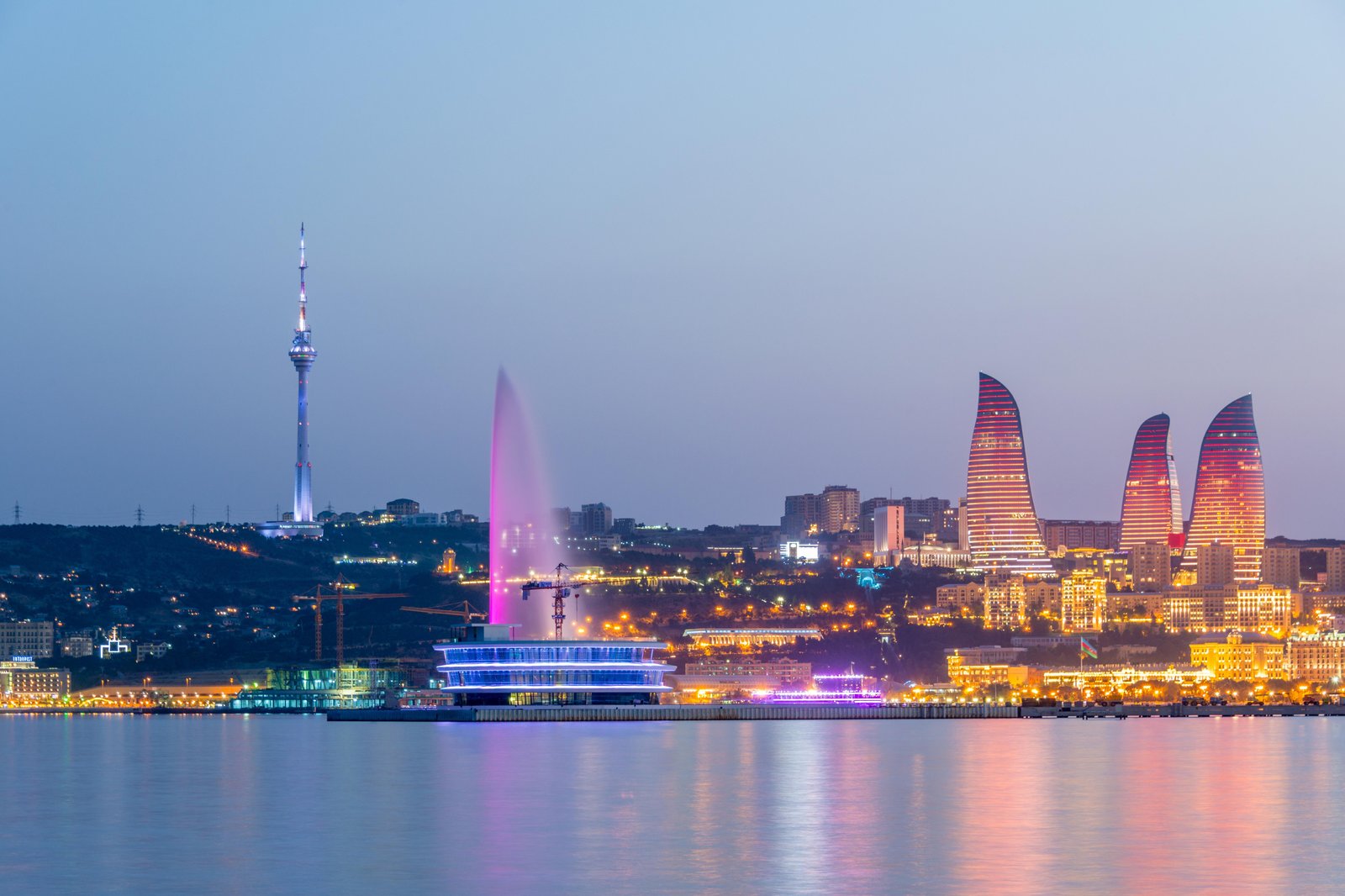
CASPIAN GATEWAY
Baku — crossroads of Europe & Asia
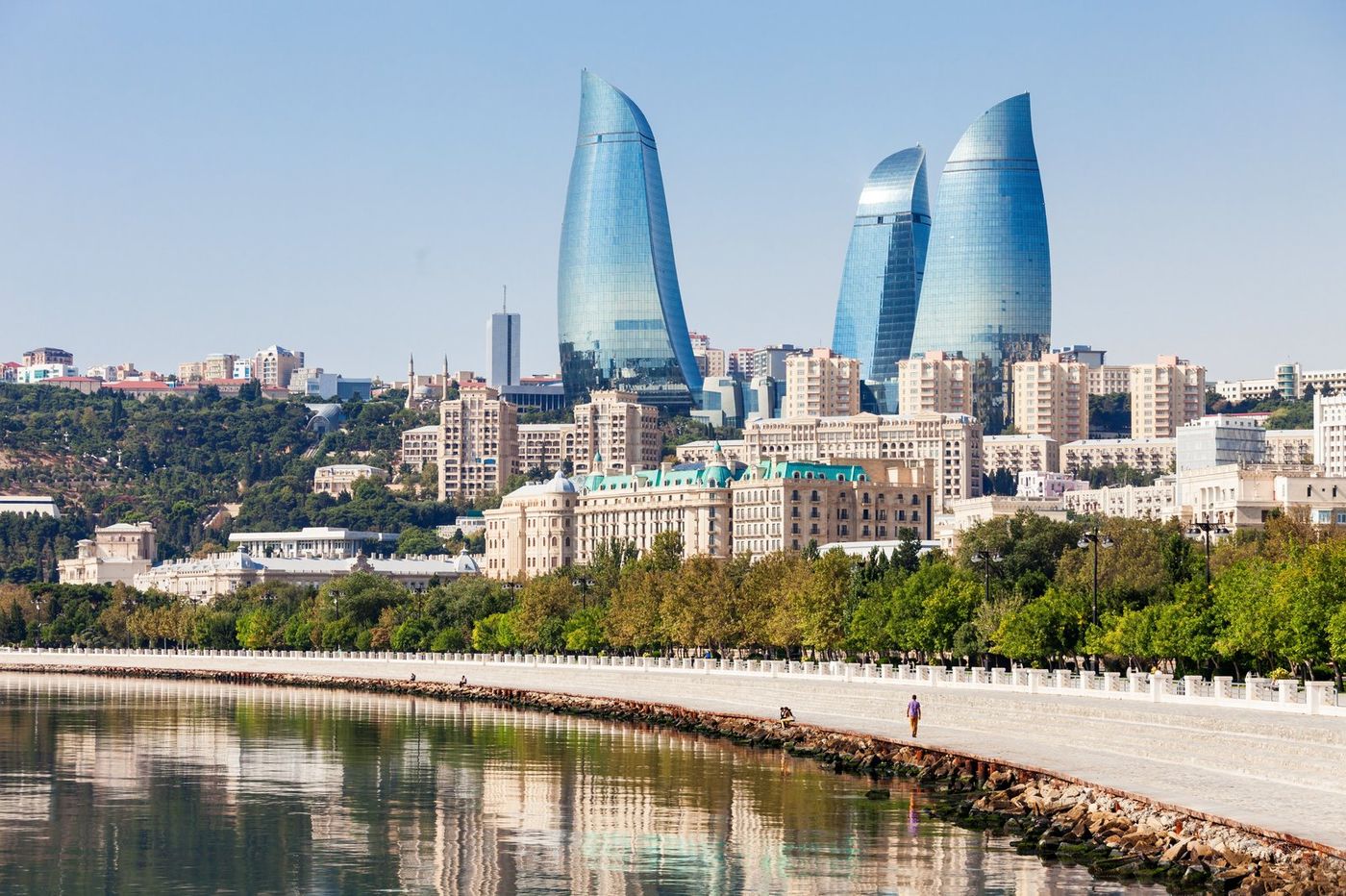
Modern business hub
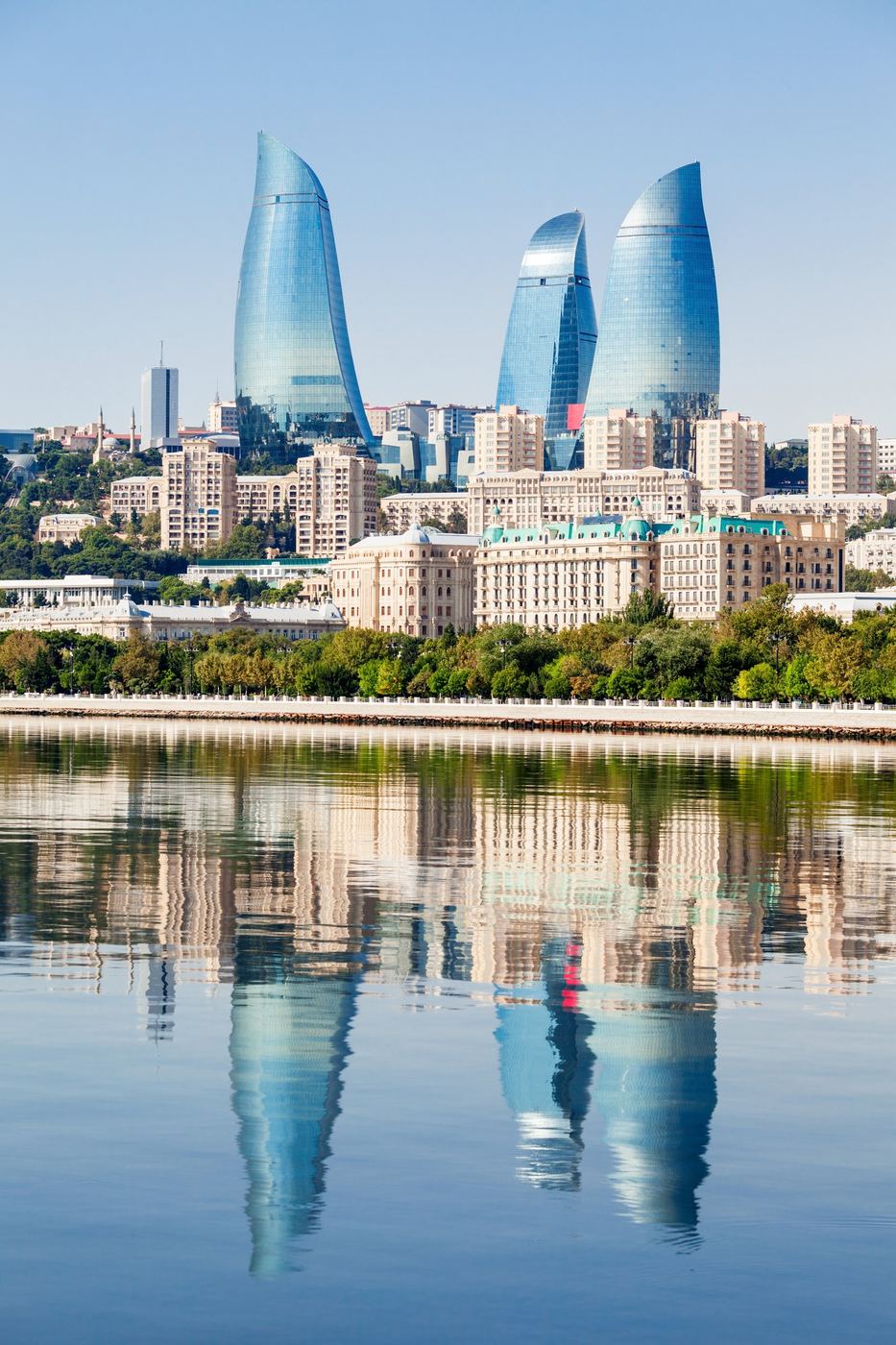
Historic Old City
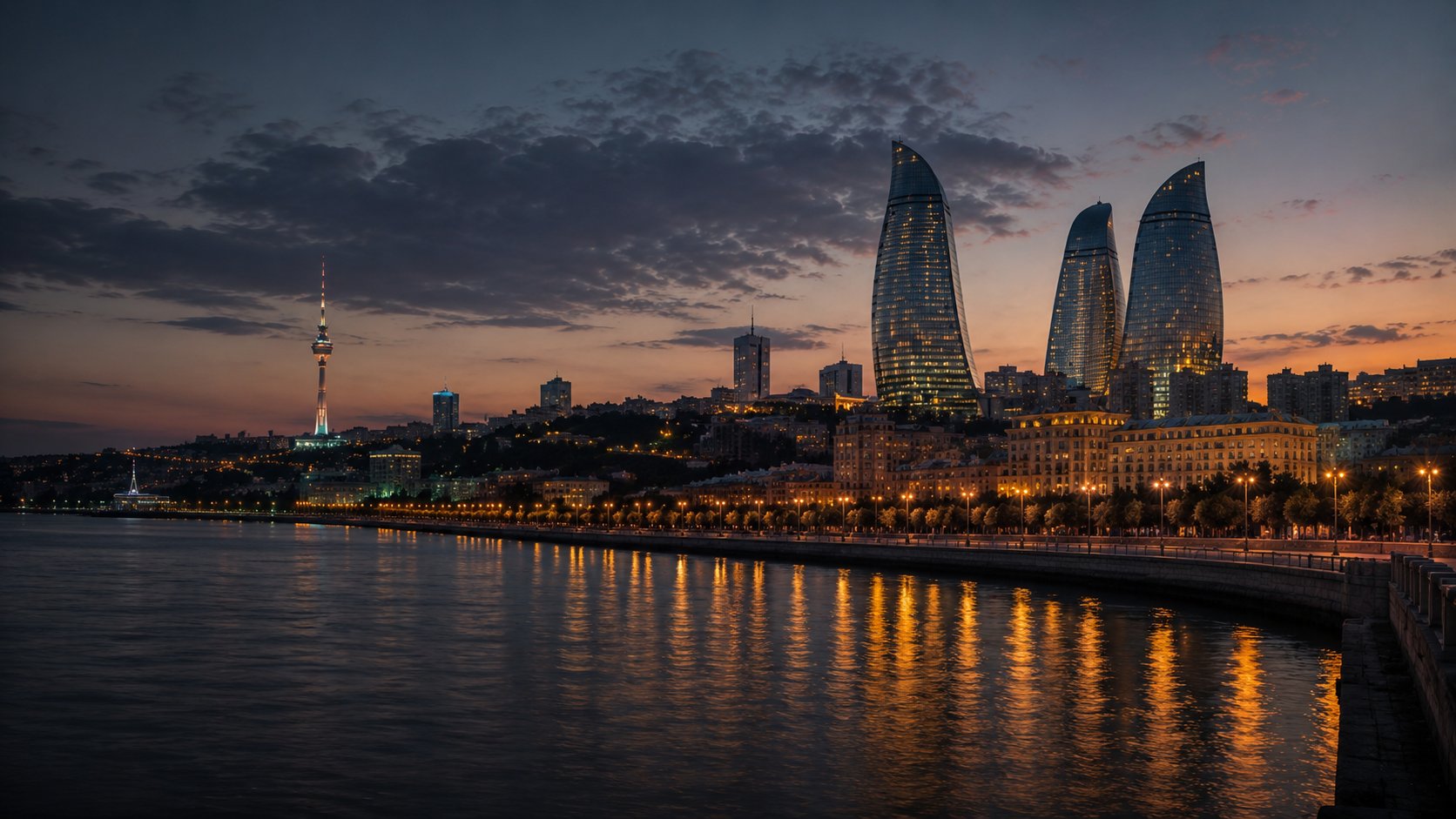
Caspian shore — Middle Corridor
Azerbaijan is the energy and logistics anchor of the Caspian region, the 4th-largest pipeline gas supplier to the EU, host of COP29, and the indispensable spine of the Middle Corridor connecting China and Europe.
Independent since 1991, modernized at scale, and strategically positioned where Europe meets Asia — Azerbaijan is one of Europe's most consequential energy partners and the Caspian region's most consequential modern economy. From hosting COP29 to anchoring the Middle Corridor, the country has emerged as a strategic actor with global reach.
Azerbaijan sits at one of the most strategically valuable geographic intersections in the world: the meeting point of the Caspian Sea, the South Caucasus mountains, the Iranian plateau, and the Eurasian steppe. It is the only country bordering both Russia and Iran with a direct EU partnership orientation.
For decades, Azerbaijan was understood primarily through its energy resources — oil and gas reserves that fueled European supply diversification, particularly through the Southern Gas Corridor delivering Caspian gas to Italy, Greece, Bulgaria, and Romania. That role has only grown more strategically important.
But the modern Azerbaijan story extends well beyond hydrocarbons. The country has invested heavily in infrastructure: the Baku-Tbilisi-Kars railway, the Port of Baku at Alat, the Heydar Aliyev International Airport, and an expanding network of highways connecting Türkiye, Georgia, and the Caspian coast.
It has built four free economic zones with EU-aligned incentive frameworks. It hosted COP29 in 2024. It has emerged as the Middle Corridor anchor — the trans-Caspian trade route that connects China to Europe via Kazakhstan, the Caspian Sea, Azerbaijan, and Türkiye, bypassing both Russia and the longer southern routes.
For Polish enterprises, Azerbaijan offers three things: direct access to Caspian energy and infrastructure projects, a logistics gateway to Central Asia and beyond, and a partner market with rapidly modernizing regulation, real growth, and underexploited cooperation potential.
Azerbaijan sits at the geographic center of the trans-Caspian trade route — the alternative to traditional northern and southern corridors, increasingly preferred by EU shippers seeking supply chain diversification.
From Chinese factories to European ports — through Azerbaijan. Roughly 11,000 km, 12–15 days transit time, increasing volumes year-on-year.
Russia, Iran, Türkiye, Georgia, Armenia
Direct sea access to Central Asia
~3.5h direct flight time
Working hours overlap is substantial
Azerbaijan combines one of the world's strongest reserve-to-import ratios with active diversification beyond hydrocarbons. Non-oil GDP grew 6.2% in 2024, driven by construction, transport, IT, hospitality, and manufacturing. The country runs persistent current account surpluses, has low external debt, and maintains a sovereign wealth fund larger than the GDP of most CIS economies.
Share of GDP by sector — Azerbaijan's diversification trajectory.
Azerbaijan is the cornerstone of European energy diversification. In 2024 the country delivered 25.2 BCM of gas to 14 countries, with 12.9 BCM directly to the EU — making it the bloc's 4th-largest pipeline gas supplier after Algeria, Norway, and the UK, and the 2nd-largest supplier to Italy. Eight EU member states now receive Azerbaijani gas via the Southern Gas Corridor.
The 3,500-km SCPX → TANAP → TAP pipeline system delivers Azerbaijani gas from Shah Deniz across Türkiye, Greece, Albania, and Italy. 12.9 BCM delivered to EU in 2024 (+9% YoY). Italy, Greece, Bulgaria, Romania, Hungary, Croatia, Slovenia, Slovakia — all on the receiving end. Capacity expansion underway to reach 20 BCM/year.
BP-operated Azeri-Chirag-Gunashli (ACG) and Shah Deniz mega-projects. SOCAR partners with BP, ExxonMobil, Equinor, TotalEnergies. New $2.9B BP investment at Shah Deniz approved in 2025 — extracting an additional 50 BCM over project lifetime.
Azerbaijan hosted COP29 in November 2024. Major wind (Khizi-Absheron 240MW), solar (Garadagh 230MW with Masdar), and offshore wind projects underway. Caspian offshore wind potential exceeds 157 GW.
BTC (Baku-Tbilisi-Ceyhan) — one of the world's longest oil pipelines. SCP (South Caucasus Pipeline). TANAP/TAP — the strategic gas arteries. Combined, they form Europe's only non-Russian land route from the Caspian basin.
Strategic agreement between Azerbaijan, Georgia, Romania, and Hungary (2022). 1,195-km submarine HVDC cable under the Black Sea will export Caspian renewable electricity directly to EU grids — co-financed by the European Commission.
Azerbaijan operates four major free economic zones with significant tax exemptions, customs simplification, and infrastructure support — designed to attract foreign manufacturing, logistics, and services investment.
The flagship FEZ at the Port of Baku — Azerbaijan's largest. Logistics, manufacturing, trade, and re-export with full corporate tax holiday and customs exemptions.
Heavy industry hub — chemicals, petrochemicals, metallurgy. Major SOCAR facilities. Investor incentives include 7-year profit tax exemption and customs duty holiday.
Textile and industrial manufacturing zone. Strategic positioning in central Azerbaijan with rail access. Specialized in cotton processing, garment manufacturing, and food processing.
Pharmaceutical manufacturing zone. EU-aligned GMP standards. Strong incentives for pharma investors with infrastructure support and skilled workforce access.
Construction materials and building components hub. Cement, glass, and ceramics manufacturing. Supplies the booming Azerbaijani and regional construction markets.
Up to 100% corporate tax exemption, full customs duty exemption, simplified registration, infrastructure support, and direct dialogue with the Ministry of Economy and AZPROMO.
The cornerstone of Azerbaijan's economy. SOCAR is one of the world's largest national oil companies. Strong international partnerships with BP, Equinor, and others.
Middle Corridor anchor. Port of Baku at Alat is the largest Caspian port. BTK railway connects Caucasus to Europe via Türkiye. Strategic to global supply chains.
Major rebuilding of liberated territories (Karabakh region) — multi-billion infrastructure program. Real estate development. Public infrastructure modernization continues nationwide.
Massive renewable energy expansion. Wind (240MW Khizi-Absheron), solar projects across multiple regions. Caspian offshore wind potential of 157+ GW. Major foreign investment opportunities.
Strong cotton, fruit, wine, and tea production. Major government support for agricultural exports. Growing hazelnut, pomegranate, and specialty product exports to EU markets.
Government Digital Azerbaijan strategy. Strong push for IT exports. Growing fintech ecosystem. Tax incentives for IT companies in technology parks.
Azerbaijan has become one of the fastest-growing tourist destinations in Eurasia — combining UNESCO heritage, modern luxury, mountain landscapes, and a coastal Caspian experience that feels both familiar and exotic to European visitors.
Explore tourismUNESCO Old City (İçəri Şəhər). Flame Towers. Heydar Aliyev Center by Zaha Hadid. World-class cuisine, hotels, and Caspian boulevard.
Azerbaijani carpet weaving (UNESCO). Mugham musical tradition. International Carpet Festival in Baku (May). Regional folk traditions and Novruz celebrations.
Caucasus mountains, Shahdag and Tufandag ski resorts, Gobustan rock paintings (UNESCO), Lake Goygol, and emerging eco-tourism destinations.
Major international events: F1 Azerbaijan Grand Prix, COP29, international forums. Modern conference infrastructure. Strong hotel ecosystem (Marriott, Hilton, Four Seasons).
Heydar Aliyev International Airport — major regional hub. 7 international airports. Direct flights to Warsaw, Istanbul, Dubai, Frankfurt, London. Azerbaijan Airlines (AZAL) flies to 30+ destinations.
Largest Caspian port. 15M tons annual capacity, expanding to 25M. Key Middle Corridor node. Direct connections to Aktau (KZ), Türkmenbashi (TM), and Astrakhan (RU).
Baku-Tbilisi-Kars railway opened 2017 — direct cargo and passenger connection from Caucasus to EU via Türkiye. Game-changing infrastructure for Middle Corridor freight.
Modern motorways connecting all major cities. Baku-Tbilisi highway. New routes through liberated territories. Major investment in regional road infrastructure ongoing.
Strong e-government — ASAN service centers (one-stop government services). Growing 5G coverage. Major data center investments. Government Digital Azerbaijan strategy.
BTC oil pipeline. SCP/TANAP/TAP gas system. Synchronized electricity grid. Black Sea green cable to Romania (planned). Modern LNG and storage facilities.
Multiple specialized industrial parks. Modern logistics warehousing. Specialized clusters for petrochemicals, pharmaceuticals, textiles, and construction materials.
Strong technical education. Azerbaijan State Oil Academy, ADA University, Baku Higher Oil School. Increasing English-language programs. Growing technical talent pool.
Azerbaijani business culture combines traditional hospitality with modern professionalism. Personal relationships matter deeply — but they coexist with rigorous formality and clear hierarchy.
Download cultural briefAzerbaijani business culture is highly relational. Expect to share meals, stories, and tea before getting to the deal. This is investment in trust — not delay. Plan for it.
Hosts will go to extraordinary lengths to make guests comfortable. Reciprocity matters. When Azerbaijani partners visit Warsaw, the same level of care is expected back.
Senior decision-makers expect formal address and protocol. Address by title and surname initially. Decisions flow top-down — engage with the right level early.
Azerbaijani is the official language. Russian is widely understood, especially in business. English is common in modern business and government. Türkce (Turkish) is mutually intelligible.
State agencies (AZPROMO, ministries) play active roles in foreign business engagement. Working with these institutions accelerates access. IGPA can help facilitate.
Decisions often take time, particularly with state-aligned counterparties. But once committed, Azerbaijani partners are exceptionally loyal — long-term partnerships are the norm.
Direct links to Azerbaijani government agencies, statistical institutes, and public bodies that members and partners rely on for authoritative information.
If your enterprise is considering investment, trade, or partnership in Azerbaijan, IGPA can connect you to the right partners, advisors, and institutional contacts. Membership opens the door.